A Day of Iranian Music
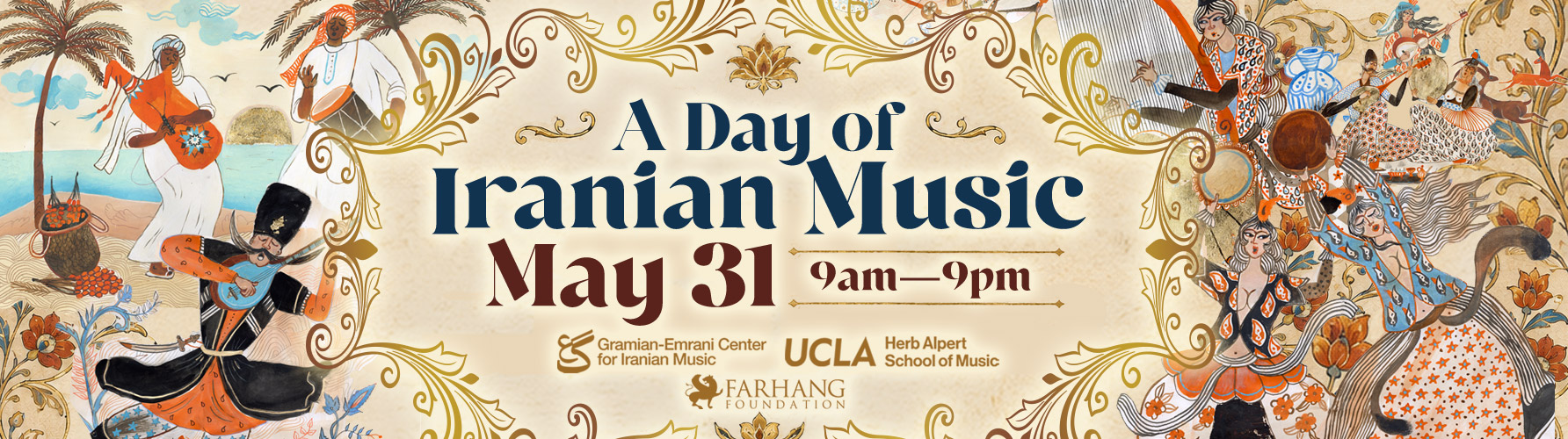
A Day of Iranian Music
May 31, 2026
at UCLA's Herb Alpert School of Music
Free Admission to all programs and performances.
The Music of Iran Ensemble performs on stage.

"A Day of Music” is a full-day event presented by the Gramian-Emrani Center for Iranian Music in collaboration with the UCLA Department of Music and the Department of Ethnomusicology, celebrating Iranian music and culture.
The event features a wide range of programs throughout the day, including conferences, symposia, lectures, workshops, outdoor performances, and an evening concert. The event is directed by Dr. Shahab Paranj, faculty member and director of the Gramian-Emrani Center for Iranian Music. The program also features performances by Pejman Hadadi, faculty member of the Iranian Music Program, together with his students. This marks the first time UCLA has hosted an event entirely dedicated to Iranian music, with plans for it to become an annual tradition.
The 66th Annual Spring Festival of World Music
Continuing a tradition begun in 1960, the Department of Ethnomusicology draws on its incredible collection of world musical instruments to present its annual Spring Festival of World Music. It's an opportunity for student ensembles to perform and share traditional musics from around the world as they master their instruments. The 2026 festival concert dates run from April 26th to June 3rd. The festival is free and open to the public. All concerts are in Schoenberg Hall and Lani Hall. We look forward to welcoming you to The UCLA Herb Alpert School of Music for our storied Spring Festival of World Music.
Lani Hall
9:00am — 9:30am
Mohammad Moridvand (From Iran on Zoom)
Hypothetical Concert: Presence, Absence, and the Politics of Iranian Musical Performance
9:30am — 10:15am
Payam Yousefi
A Sound Power of Presense: Woman, Voice and The Performance of New Feuters
10:15am — 11:15am
Mehrdad Gholami
A History of Western Music in Iran: A search for New Identity
11:15am — 12:00pm
Reza Vali
Pluralist Music
Kaveh Mirhoseini
Compositional Approach to The Music of Iran
12:00pm — 1:00pm
Azadeh Vatanpour, Sirvan Manhoobi, Kejvan Ziaoddini
Music, Identity, and Resistance in the Ethnic and Religious Soundscapes of Iran
Courtyard Performance
3:00pm — 4:00pm
Gordafarid
Persian Epic Storytelling
Schoenberg Hall
4:00pm — 5:00pm
Percussion Workshop by Pejman Haddadi
Rhythm Beyond Tombak
5:00pm — 6:00pm
Pannel Discussion
Sound or Silence: Iranian Musicians and the Dilemma of Performance.
Moderator
Dr. Shahab Paranj
6:00pm — 9:00pm Concert
Tombak Students
Borna Abadooz
Allen Yamin
Reuben Noorvash
Orelle Maghan
Ethan Kohanbaksh
Nahoko Okamoto
Candice Anvari
Soroosh Khosravi
Mia Flaieh
Advance Student
Sepanta Theo Dehghan
Auriana Gharibshahi
Pooneh Tehrani
Erisa Taghizadeh
Nic Hendifa
Music of Lurestan
Mazdak Alipour
Behfar Bahadoran
Nariman Assadi
Tanbour Music
Kimia Jamshid
Kurdish Music
Sirvan Manhoobi
Kejwan Ziaoddini
Nariman Asadi
Ensemble Iran
Pejman Hadadi
Saman Montaseri
Kimia Jamshid
Michael Aboutboul
Yaron Cherniak
Kejawan Ziaoddini
Sirvan Manhoobi
Theo Sepanta Dehghan
Auriana Gharibshahi
Compositions
Parviz Meshkatian
Jalil Andalibi
Mohammad Reza Shajarian
Morteza Neydavoud
Tahmoures Pournazeri
Director: Dr. Shahab Paranj
Faculty
About Shahab Paranj Ph.D.
Winner of the 2024 Hoefer Prize, Shahab Paranj is a composer, conductor, instrumentalist, and educator. Born and raised in Iran, he holds degrees in music composition from the San Francisco Conservatory of Music, Manhattan School of Music, and the University of California, Los Angeles. He is regarded as a leading figure among his generation of composers, distinguished for transcending Eurocentric conventions and seamlessly integrating Persian and Western compositional techniqies.
Praised by the San Francisco Examiner as “extraordinary” and lauded by composer John Adams for his “unique voice,” Paranj’s music diverges from Eurocentric conventions, drawing inspiration from the rich traditions of Persian music.
His recent commissions include works for ensembles such as the Delirium Musicum, Russian String Orchestra, Intersection Contemporary Music Ensemble, Long Beach Opera, Jâca Duo, Aleron Trio, San Francisco New Music Ensemble, One Great City Duo, MSM Symphony Orchestra, and the International Low Brass Trio. His versatility also extends to film scoring, with his original score for Dressage earning recognition when it was nominated for the 2018 Berlin Film Festival’s Generation category.
As a conductor, Paranj led The Iranshahr Orchestra in the recording of Songs of Love and Loss by Richard Danielpour, featuring the acclaimed soprano Hila Plitmann, released by Naxos in 2024.
A virtuoso tombak player, Paranj has performed, recorded, and collaborated with distinguished artists and ensembles, including the legendary Mohammad Reza Shajarian, the Tehran Symphony Orchestra, and the Pacific Symphony under the baton of Carl St. Clair. For over 15 years, he has been a dedicated collaborator with the celebrated Shams Ensemble. In addition to his mastery of Persian percussion, he was a member of the Iran National TV and Radio Symphony Orchestra as a cellist from 2003 to 2007.
As a scholar, Paranj’s primary research explores the Iranian Avazi style. He has presented his work at prominent conferences, including the joint annual meeting of SEM, AMS, and SMT in 2022. His contributions have been formally recognized by the Association of Professors and Scholars of Iranian (2024), Mehr Humanitarian Society (2010) and the City and County of San Francisco (2011).
Since 2023, Paranj has served as a faculty member and the director of the Center for Iranian Music at the UCLA Herb Alpert School of Music. He is also the founder and music director of The Iranshahr Orchestra and the artistic director of du vert à l’infini, a contemporary music festival in the Franche-Comté region of France.
About Pejman Hadadi
World-renowned, Pejman Hadadi is considered one of the most innovative Iranian percussionists. He was born in Tehran, Iran on February 19, 1969. At age 10, he began studying Tombak, the central drum in traditional Persian music, with Master Tombak player Assadollah Hejazi for two years. He owes the foundation of his training to this Master’s precise teaching. He continued his training for a brief time with Master Tombak player, Bahman Rajabi, who exposed him to an entirely different approach to playing the instrument. Pejman tirelessly followed the various styles of famous Tombak players and was captivated by such great Masters as Hossein Tehrani, Nasser Farhangfar, and Morteza Ayan, who influenced him greatly through their recordings. After some time, he felt drawn to the other main percussive instrument in the tradition, namely the sacred frame drum known as the Daf. Alongside his long hours of Tombak practice, he taught himself how to play the Daf, finding great inspiration from the great Master Daf player, Bijan Kamkar, through his recordings.
Pejman immigrated to the US in 1989 and began his professional career in 1991. After collaborating with a few different music ensembles, Oshagh and Nava, he began performing with Master musician and composer, Hossein Alizadeh in serval concerts in the US, which led him to pursue music with more diligence. In 1995, he joined Dastan Ensemble, the highly celebrated and “most-forward-looking Persian music ensemble” (LA Weekly). Pejman has recorded countless critically acclaimed pioneering works with Dastan and continues to perform with the ensemble in some of the world’s most noted concert halls.
In the year 2000, along with Behnam Samani, Reza Samani, Hakim Ludin, Javid Afsari Rad, and Morshed Mehregan, he revolutionized the first Iranian percussion ensemble, ZARBANG with whom he has performed extensively in major international festivals and prestigious concert halls in Europe, North America, and Hong Kong. His ground-breaking recordings with this ensemble include Rengineh, Middle Eastern and World Percussion, and Call to Love.
Concurrent with his activities with Dastan Ensemble and ZARBANG, Pejman began performing and recording with various Iranian musicians and from other cultures. The impressive list of these musicians includes Hossein Alizadeh, Shahram Nazeri, Homayoun Shajarian, Kayhon Kalhor, Parissa, Shujaat Hussain Khan, Omar Faruk Tekbilek, Hossein Omoumi, Sima Bina, Salar Aghili, Ali Akbar Moradi, Hafez Nazeri, Ardeshir Kamkar, Matthaious Tsahourides, Nejati Celik, Halil Karadoumon, Yair Dalal, Imamyar Hasanov, Rajeeb Chakraborti, Adam Rudolph, Brad Dutz, Gregg Ellis and Yuval Ron among others.
These collaborations, specifically with non-Iranian musicians, inspired him to explore and research the world of rhythm in different cultures, especially those of neighboring Iran. Being distinctively drawn to the body of rhythm in India, he began to study the Tabla for two years to understand cyclic rhythms. Learning the technique of Tabla and its different rhythmic patterns significantly influenced his methodology and attitude toward playing the Tombak.
Considered one of the most notable Iranian Tombak players, Pejman has created a distinct signature style that has greatly impacted Tombak players of his own generation and after. One of his innovations is adding a piece of skin onto the frame of the Tombak to create variety, color, and a specific sonic atmosphere. Another one of his innovations is a new version of custom-made tunable frame drums called Pezhvāk or Davaayer-e Kooki. These drums come in various sizes to create harmonic intervals based on the sound of percussion in traditional Persian music. Designed to be assembled on specific stands, these frame drums can be set up to be played simultaneously and with other appropriate percussive instruments like the Tombak, which adds a greater dimension to the sound and color of ensemble music. Pejman used this combination for the first time in his concerts with Dastan Ensemble and their album Shurideh. Pejman’s combination is now enjoying a wide reach and popularity among the new generation of percussive artists.
Among Pejman’s achievements is his collaboration with REMO, one of the world’s largest manufacturers of synthetic skin and percussive instruments. After years of experimentation, Pejman succeeded in finding access to a certain kind of synthetic skin, which, when placed on the frame of the Daf yielded an agreeable, authentic sound. Since his success in 2009, REMO began manufacturing the Daf with a very appealing design and quality, spreading its popularity among percussionists worldwide.
For years, concurrent with his performing career, Pejman has been very active in teaching and educating people in the arena of rhythm and percussion. He has numerous instruction manuals that await publication. He received the prestigious Durfee Foundation Master Musician Award twice for disseminating and propagating Persian music in the US. In 1999, he founded Neyreez World Music Institute in Southern California, where, for years, he taught classes alongside other notable musicians.
Since 1999, Pejman has composed a large body of music for dance, which he has performed extensively in concert with renowned dancer and choreographer, Banafsheh Sayyad and her ensemble, NAMAH, in Europe and North America, marking the first time Contemporary Persian dance and music were brought onto the stage.
Pejman has also been active in film music. His recordings include Prince of Egypt and Prince of Persia. He was commissioned by the Los Angeles Master Chorale and performed at Disney Hall with the Choral in 2007.
He is currently a lecturer in the Department of Ethnomusicology at UCLA.
Bios and Abstracts
About Mehrdad Gholami
A History of Western Music in Iran: A search for a new Identity
Western Washington University
This lecture traces the history of Western classical music in Iran as part of a broader search for cultural and artistic identity. Rather than treating Western music as a simple import, it examines how Iranian musicians and institutions shaped and reinterpreted it across different historical periods.
The story begins in the Qajar era (1789–1925), when Western music entered Iran through state institutions such as the Dar al-Fonoon (1851). Initially tied to military and technical training, Western musical practices gradually expanded beyond their original function and laid the groundwork for later developments.
During the Pahlavi period (1925–1979), these foundations evolved into a more coherent cultural project. Figures such as Ali-Naqi Vaziri and Gholam Hossein Minbashian played central roles in defining music education and performance. At the same time, institutions including conservatories, orchestras, and the University of Tehran formalized Western music within Iran’s cultural infrastructure.
This lecture gives particular attention to the emergence of orchestral life in Tehran and to conductors such as Heshmat Sanjari and Farhad Meshkat, whose work positioned Iran within a global musical network. At the same time, composers including Aminollah Hossein, Ahmad Pejman, and Alireza Mashayekhi explored ways of integrating their Persian identity into the newly minted Tehran Symphony.
A case study of Hossein Nassehi’s 1959 flute concerto highlights this synthesis in practice, revealing how modal structures such as Chahargah can be reinterpreted within a Western compositional framework.
The lecture concludes by reflecting on the disruptions of the 1979 Revolution and the continuing negotiation of musical identity in Iran.
Iranian flutist Mehrdad Gholami has received numerous accolades throughout his career, including the Presidential Award and the Iran National Elites Foundation Scholarship, supporting him to attend the University of Tehran’s School of Fine Arts.
A recipient of the Susan and Ford Schumann Fellowship, Mehrdad attended the Aspen Music Festival, serving as the flute fellow for the Aspen Contemporary Ensemble (ACE) for three consecutive summers (2017-2019). Later, he also served as the Contemporary Flute Fellow at the Atlantic Music Festival.
Mehrdad’s commitment to promoting Iranian music is exemplified in his first solo album, which was released in collaboration with his alma mater, the University of Tehran, and the Iran Flute Society. His ongoing efforts to present, perform, and publish new compositions by Iranian composers have spurred a growth of flute works from Iran, inspiring similar projects under his “Iran Flute Project.” Mehrdad’s doctoral dissertation on the same topic won the National Flute Association’s Graduate Research Competition in 2023. His latest album, This Vast Sky, was released in the Summer of 2024 and is available for streaming on all major platforms.
In recognition of his work, Mehrdad was awarded the 2025 Fellowship Award by Artist Trust to further his initiatives in promoting and recording new flute music.
As an orchestral flutist, Mehrdad has performed with several prominent ensembles, starting with the Tehran Contemporary Ensemble, Tehran City Hall Orchestra, and Tehran Symphony Orchestra (TSO), where he eventually served as principal flutist. His international orchestral experiences include performing with the Kaleidoscope Chamber Orchestra (Los Angeles), Fort Worth Symphony, and McKinney Philharmonic.
Dr. Gholami is the Assistant Professor of Flute and Coordinator of the Woodwinds Area at Western Washington University. For more information about his projects and performances, visit www.MehrdadGholami.com.
Azadeh Vatanpour PhD, Sirvan Manhoobi and Kajwan Ziaoddini
Music, Identity, and Resistance in the Ethnic and Religious Soundscapes of Iran
This panel explores the ways in which marginalized communities in Iran mobilize music and sound as venues of spiritual meaning, political identity, and cultural resistance. Bringing together ethnographic and theoretical perspectives, the three papers investigate how sacred soundscapes, musical ownership claims, and shifting performance practices articulate complex relationships between tradition, modernity, and power.
The first paper, Echoes of the Divine, explores Yārsān sacred music as both a spiritual realm and a form of sonic resistance, drawing on acoustemology theory to show how the ritual of tanbur performances evoke divine presence while countering cultural assimilation. The second, Theft Songs, analyzes Kurdish digital discourses that accuse Persian and Turkish musicians of “stealing” melodies, framing these narratives as ethnonational boundary-making strategies rooted in histories of structural marginalization. The third, Sacred Strings and Mundane Tides, applies Thomas Turino’s participatory–presentational framework to trace the transformation of Yārsān musical practice from a sacred, participatory performance to a commodified art form in global markets.
Together, these studies reveal how musical practices—whether through performance, discourse, or digital mediation—become vehicles for asserting sovereignty over cultural expression in contexts of political repression and cultural erasure. By foregrounding sound as both an aesthetic and political act, the panel highlights the central role of music in shaping ethnic and religious identities and contesting hegemonic narratives in contemporary Iran.
Azadeh Vatanpour is the Executive Director of the Persian Cultural Center of Atlanta. She holds a Ph.D. from Emory University, an M.A. in Ancient Iranian Culture and Languages from Shiraz University, and M.A.s in Folk Studies and Religious Studies from Western Kentucky University. As a scholar of religion and minority studies, her research focuses on ethno-religious minority communities in the Middle East, with particular emphasis on the Yarsan. She serves as an associate editor for the International Journal of Persian Literature and for the Iranian and Persian Studies book series published by Springer. She is also a board advisor for Encyclopaedia Iranica. Vatanpour’s edited volume, Essays on Gurani Literature (co-edited with Dr. Alireza Korangy), explores the rich literary traditions of texts composed in the Gurani language by diverse ethno-religious groups of the Zagros region. Azadeh is co-authoring Echoes of the Divine: The Maqām Tradition and Esoteric Belief in Yārsān Thought with Sirvan Manhoobi, under contract with Macmillan.
Kajwan Ziaoddini is a Ph.D. candidate in ethnomusicology at the University of Maryland. His current research explores the dynamics of music, identity, and politics, with a focus on the role of music in negotiating competing ideologies among Kurdish-Iranians. His broader research interests include music, ethnicity, and nationalism; Sufism; media and online communities; and music theory in ethnomusicology. He has presented his work at the annual meetings of the Society for Ethnomusicology and the Middle East Studies Association. His publications include “Analyzing Structural Relationship of Dastgahi Music in Iran and Kurdistan Music” in Fine Arts Journal, and an upcoming article in Asian Music journal titled “Music Theory at the Crossroads of Cultural Encounters: A Reflection on Dariush Talai’s Contributions to the Analysis of Iranian Classical Music.” Besides his scholarly work, Kajwan is an accomplished santur performer specializing in the Persian radif repertoire and has released three solo recordings.
Sirvan Manhoobi is a Kurdish Iranian multi-instrumentalist, composer, and educator specializing in Iranian classical and folk music. He holds a master’s degree in archaeology from the University of Tehran and a master’s degree in music from San Francisco State University, and is currently a PhD student in ethnomusicology at the University of Maryland. His research explores Kurdish and Yaresan music and their intersections with politics and capitalism. Manhoobi has collaborated with renowned artists such as Bahram Beyzai, Shahram Nazeri, and Bijan Kamkar. He is currently co-authoring a book with Azadeh Vatanpour titled Echoes of the Divine: The Maqām Tradition and Esoteric Belief in Yārsān Thought.
About Mohammad Moridvand
Hypothetical Concert: Presence, Absence, and the Politics of Iranian Musical Performance
In December 2024, a musical event titled the “Hypothetical Concert,” featuring vocalist Parastoo Ahmadi and several accompanying musicians, took place at a historic caravanserai in Iran. Unlike conventional performances, this concert took place without a physical audience present. The artists pre-recorded the performance and released it on YouTube, and the event simulated a live and collective experience through the active engagement of viewers on social media, who synchronized their viewing of the concert at the announced time. In this paper, I build on Heidegger’s account of presence and absence to argue that the “Hypothetical Concert” is not merely a musical event but a complex philosophical and social phenomenon in which the physical absence of the audience creates the foundation for a renewed, reconfigured mode of presence. The vocalist’s self-chosen attire, the selection of protest songs, and direct engagement with governmental restrictions turned the concert into a symbol of resistance and dissent. These choices, in turn, sparked wide-ranging legal and cultural responses, underscoring the event’s profound social impact. This audience-free staging reflects the contemporary condition of Iranian society. The “Hypothetical Concert” and reactions, such as judicial intervention and censorship, attempt to deny a reality that is already in effect. This absence stems from the ongoing prohibition of women’s singing in public concert settings. This ban on women’s vocal performances, alongside compulsory dress codes, has generated new vocabularies of performance that blur boundaries between live-streamed, non-attended events and offline releases.
Mohammad Moridvand holds an M.A. in Ethnomusicology from the University of Art in Tehran and is a tar and setar player. His earlier research centered on questions of performance in Iranian classical music, exploring the role of the sorna among the ethnic communities of Lorestan in western Iran. His current work brings together music, media, and gender, asking how music videos, livestreams, and other mediated forms reshape performance, gendered voice, and dissent in contemporary Iran.
About Payam Yousefi
A Sound Power of Presence: Women, Voice, and the Performance of New Futures
Since the 1979 Islamic Revolution, female vocalists in Iran have been banned from singing solo in public under the assumption that the musical feminine voice will corrupt society. Despite this repressive context, silence has never been the case and women have sustained their careers through a myriad of subversive strategies.
This talk explores these strategies through the career of Masoumeh Mehrali, a prodigy of the legendary Mohammad Reza Shajarian in the 1980s, whose story exemplifies the challenges of a master female vocalist sustaining a career without the privileges of prerevolutionary fame. Over the past forty-six years, in addition to establishing herself as master musician, she has also trained a new generation of female singers who continue to challenge the limits of the ban’s enforcement.
Building on Assef Bayat’s concepts of “power of presence,” “social non-movements,” and “quiet encroachment” within authoritarian systems, this talk considers how women’s consistent presence in the musical arena has changed the standards of permissibility since 2005—drawing on a cumulative eight years of fieldwork over a nineteen-year span. Importantly the nature of these presences—i.e., Mehrali’s work that synthesizes the feminine voice, music, and Sufi poetry—function as alternative modes of subversive ethics. Thus, women’s online and underground performances, as well as their established networks of transmission, articulate new “ethical feminine voices” that negate the assumptions of their voices’ immorality.
This talk further explores how today’s musical culture harnesses a unique power to imagine and perform alternative realities on online platforms, posing threats to the ideological foundations of authoritarian regimes in a manner that eludes their policing tools.
Payam Yousefi (PhD Harvard, 2023) is an assistant professor of ethnomusicology at the University of Florida specializing in the intersections of music and politics in the Middle East and the US. Currently Yousefi is a Visiting Assistant Professor in the Yale Department of Music and a Long-term Fellow at the Yale Institute of Sacred Music. His book project titled, Subversive Sounds: Music and Authoritarianism in Modern Iran tells multiple stories of how Iranian musicians’ have transcended authoritarian controls over the past 19 years. Presenting case studies in four genres—traditional, classical, sacred, and popular—the book argues for music’s efficacy as a tool to inscribe material changes in authoritarian political contexts where explicit protest is violently suppressed. Importantly, Yousefi explores how musicians’ ethically framed practices, not only mediate social movements, but also imagine and enact new socio-political futures. His past research on the musical resistance among female vocalists in Iran was awarded both the “Charles Seeger Prize (2019)” and the “James T. Koetting Prize (2018)” by the Society for Ethnomusicology. In 2023 he was awarded SEM’s “Religion, Music, and Sound Section Paper Prize” for his research on Anti-Theocracy Protests in Iranian Shi’ite Chanting Rituals. Most recently, his solo album for the kamāncheh, Songs of Hope (2025) was awarded a Global Music Award, showcasing his improvisatory and compositional prowess in the Persian dastgāh tradition. His forthcoming scholarship includes a chapter in , ed. Siamdoust & Chehabi, where he considers the non-coercive power of Iranian women’s vocal performances in online and offline counter-publics—arguing that women’s subversive musical performances play on “social poetics” to engender contrasting notions of respectability, in effect limiting the power of authorities to enforce restrictions. At the University of Florida Yousefi is also affiliate faculty in the Center for Global Islamic Studies and the Center for Arts, Migration, and Entrepreneurship. In addition to this he founded and directs UF’s Persian Music Ensemble.
About Reza Vali
Pluralism in Music
was born in Ghazvin, Iran, in 1952. He began his music studies at the Conservatory of Music in Tehran. In 1972 he went to Austria and studied music education and composition at the Academy of Music in Vienna. After graduating from the Academy of Music, he moved to the United States and continued his studies at the University of Pittsburgh, receiving his Ph.D. in music theory and composition in 1985. Mr. Vali has been a faculty member of the School of Music at Carnegie Mellon University since 1988. He has received numerous honors and commissions, including the honor prize of the Austrian Ministry of Arts and Sciences, two Andrew W. Mellon Fellowships, commissions from the Pittsburgh Symphony Orchestra, the Boston Modern Orchestra Project, the Pittsburgh New Music Ensemble, Kronos Quartet, the Carpe Diem String Quartet, the Seattle Chamber Players and the Arizona Friends of Chamber Music, as well as grants from the Pennsylvania Council on the Arts, The Pittsburgh Foundation, and the Pittsburgh Board of Public Education. He was selected by the Pittsburgh Cultural Trust as the Outstanding Emerging Artist for which he received the Creative Achievement Award. Vali's orchestral compositions have been performed in the United States by the Pittsburgh Symphony, the Seattle Symphony, the Boston Modern Orchestra Project, the Baltimore Symphony, the Memphis Symphony Orchestra, and Orchestra 2001. His chamber works have received performances by Cuarteto Latinoamericano, the Pittsburgh New Music Ensemble, the Carpe Diem String Quartet, Kronos Quartet, the Seattle Chamber Players, and the Da Capo Chamber Players. His music has been performed in Europe, China, Chile, Mexico, Hong Kong, and Australia and is recorded on the Deutsche Grammophon, Naxos, New Albion, MMC, Ambassador, Albany, and ABC Classics labels.
About Kaveh Mirhoseini
Compositional Approach to The Music of Iran
Kaveh Mirhosseini is a Composer, a Conductor, an Artistic Director at Cantus Ensemble, a Percussionist, a Persian Folkloric Music Researcher, a Lecturer, and also the founder of Middle East Composers Association (MECA). He was born in Iran -Tehran in an art-based family. He was inspired by his father who taught him how to Play Tombak(An Iranian percussion Instrument) and his mother’s advice (Prof.Shahla Milani, Opera Singer & Choir Conductor), he has learned music in a strict musical atmosphere.
He became familiar with the late Master Hamed Mohajer, and learned musical knowledge from him then he by choosing Composition entered the Tehran University of Art & Architecture Faculty of Music. He passed Musical Composition courses with Hooshyar Khayam. One of his important activities that is well known between musicians who know him is researching and recording Iranian Folkloric music and he owes these to Maestro Mohammad-Reza Darvishi.
In 2021, he was chosen by Musical Directory and committee of Fadjr Music Festival as an Honorary Musician for his composing and conducting “Illumination” Concerto for Violoncello & String Orchestra. He received the BARBOD Music award which is the highest musical award in Iran. By his conducting the film music of “Without Anything-which was composed by Hamed Sabet with Tehran Symphony Orchestra’s performance, the movie won the first place and SIMORGH Award.
Outdoor Performance
About Gordafarid
The Birth of Rostam: By the Aid of Simurgh
This story recounts the excruciating and miraculous birth of Iran’s greatest mythological hero, Rostam. His mother, Rudaba, endures an exceptionally difficult pregnancy because the infant in her womb is extraordinarily large and heavy. As the ninth month arrives, Rudaba faints from the severe pain, leaving the midwives and physicians utterly hopeless of saving both the mother and the child.
In this moment of despair, Zal (Rudaba’s husband) remembers the magical feather of the Simurgh—the mythical creature who raised him—and sets it on fire. The Simurgh appears instantly and instructs them to induce a deep sleep in Rudaba using wine, and then to surgically open her flank to deliver the child safely. This remarkable procedure, known today as a Caesarean section, occurred in Persian mythology centuries before the birth of Julius Caesar. The miraculous surgery is performed successfully. Upon the birth of this formidable infant, his exhausted yet relieved mother exclaims, "Berastam!" (meaning "I am delivered!" or "I am free!"). Hence, the child is named Rostam—a boy who, by the age of six, possesses the strength and stature of a seasoned warrior.
Symbolism in the Story
In this epic tale, every character embodies a profound concept:
The Simurgh: Represents absolute wisdom, sacrifice, divine medicine, and celestial guardianship.
The Simurgh’s Feather and Ash: Act as an alchemy or a miraculous panacea with extraordinary healing and wound-binding powers, symbolizing humanity's connection to the higher forces of nature.
Zal: (Rostam’s father, born with snow-white hair) Symbolizes the bridge between the mortal realm and the spiritual world.
Rudaba: (Rostam’s mother) Represents love, ultimate sacrifice, and enduring hardships to nurture the future generation.
Sindukht: (Rudaba’s mother) Employs the archetype of a wise, resourceful woman and a matriarch who protects her family through crises.
Mehrab Kaboli: (Rudaba’s father) Represents rationality and strategic thinking in times of deadlock.
The Mobad (Priest/Physician): Symbolizes science, surgical skill, and the execution of divine commands.
Rostam: Born through this unique flank-delivery surgery (traditionally called *"Rostam-Zad"* or "Rostam-born" in Iran), he stands as the eternal symbol of strength, courage, and the ultimate protector of the homeland.
The first female Iranian "Naqqal" (traditional Epic Storyteller) of Ferdowsi’s "Shahnameh" (The Epic Book of Kings), Gordafarid has excelled in performing the traditional narration of the Persian epic stories (Naqqali) since 1998. She has continued her research through the meticulous collection of narratives from all over Iran. She has also patiently followed the footsteps of old masters of this ancient dramatic art. Gordafarid has come a long way in challenging conventional social norms that consider "Naqqali" as an art form performed solely by men and only for men in public places such as neighborhood coffeehouses. Her perseverance and determination bore fruit when Morshed Torabi, the most famous "Naqqal" of Iran, prized her with his cane to recognize her achievements.
Ticketing
This event is FREE! No RSVP required. Early arrival is recommended.
Parking
Self-service parking is available at UCLA’s Parking Structure #2 for events in Schoenberg Music Building and the Evelyn and Mo Ostin Music Center. Visitor parking is marked by a green circle and the letter “P” and is on the lower levels (do not go up the ramp to levels 3-7). Costs range from $4 for 1 hour to $15 for all day. Evening rates (after 4 p.m.) are $3-$5 for 1 to 2 hours and $10 for all night. Learn more about campus parking.
Accessibility
The UCLA Herb Alpert School of Music is eager to provide a variety of accommodations and services for access and communications. If you would like to request accommodations, please do so 10 days in advance of the event by emailing ADA@schoolofmusic.ucla.edu or calling (310) 825-0174.
Photography
The UCLA Herb Alpert School of Music welcomes visitors to take non‐flash, personal‐use photography except where noted. Share your images with us @UCLAalpert / #UCLAalpert on Twitter + Instagram + Facebook
Food & Drink
Food and drink may not be carried into the theaters. Thank you!
Acknowledgment
The UCLA Herb Alpert School of Music acknowledges the Gabrielino/Tongva peoples as the traditional land caretakers of Tovaangar (the Los Angeles basin and So. Channel Islands). As a land grant institution, we pay our respects to the Honuukvetam (Ancestors), ‘Ahiihirom (Elders) and ‘Eyoohiinkem (our relatives/relations) past, present and emerging.
Event Details
| Event Starts | 05/31/2026 – 9:00 am |
| Event Ends | 05/31/2026 – 9:00 pm |
| Individual Price | This event is FREE! No RSVP required. |
| Location | UCLA - Schoenberg Hall |